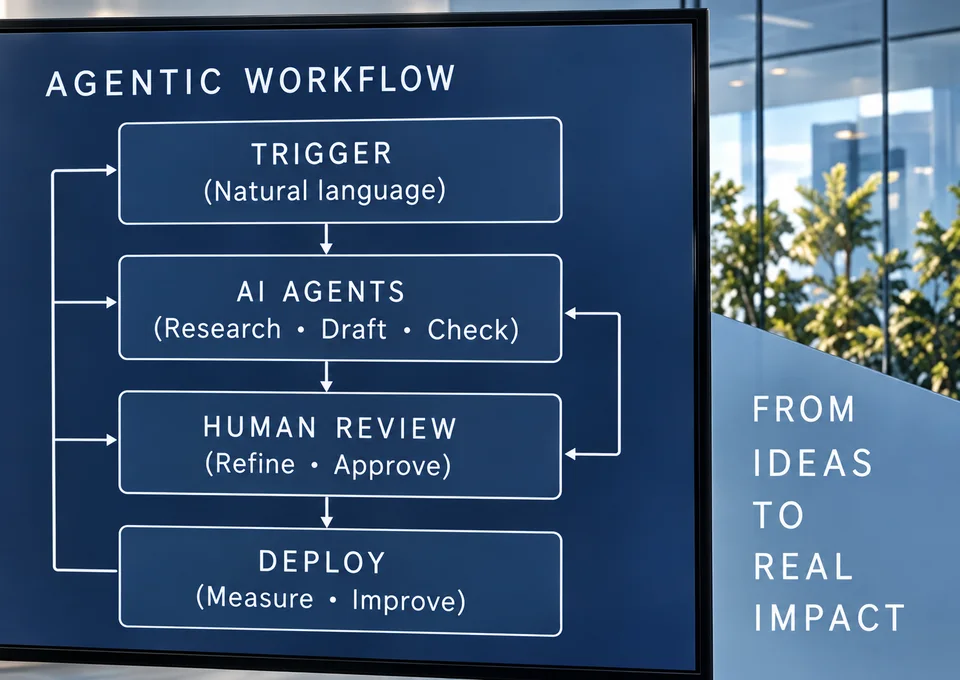
An agentic system combines a goal, relevant information, tool use and operating rules. The interesting part is not a chatbot’s answer. It is how the system chooses the next step, checks what it knows and stays within its authority.
Not the same thing as choosing a champion project
In Dealer AI Champions, a coach helps an employee select work they can understand and improve. Here, we are discussing the design of a system: knowledge sources, reasoning, tools, integration and operating controls. A champion can own the business task, while specialist engineers own the technical implementation.
A customer asks a question
Imagine a customer asks about a vehicle shown in a social post and whether a visit can be arranged. A useful system may need the approved product description, current stock information and an authorized appointment tool. A fluent answer cannot substitute for any of those sources.
The following sequence is deterministic, with synthetic information. It does not call an AI model, access a CRM or DMS, contact a customer or make a real booking.
Five design questions behind the experience
What goal is the agent allowed to pursue?
Define the intended outcome and the boundaries. Helping a person prepare a relevant response is different from being authorized to send messages or commit a booking.
Which information is authoritative?
Product descriptions, stock, customer preferences and availability have different owners and update cycles. Retain provenance and handle missing, contradictory or outdated information explicitly.
Which tools can it choose?
Tool access should correspond to the task. Reading an approved product record, checking an inventory source and creating an appointment require different permissions and controls.
When does a person take over?
Set the decision points for uncertainty, permission failure, sensitive information and consequential actions. Human oversight needs a meaningful decision and the evidence to make it—not just a button labeled approve.
What remains after the action?
Record what information was used, which tool was called, who approved the action and what happened. Agree monitoring, exceptions, recovery and future changes before live operation.
Where Dr. Cheng’s background connects
Automotive data and analytics experience helps frame which customer signals matter, how information should be structured and what makes the resulting action useful. AINERGY’s Agentic AI practice connects that perspective to agent design and implementation. It is not presented as a generic workflow-assessment form.
What needs to be tested
Test the ordinary case and the conditions that break it: an unavailable tool, a stale record, a conflicting customer request, missing authority or an attempted action outside scope. A convincing normal-case demonstration is only one part of the evidence needed for operation.
Bring the real question.
A guide can frame the issue. AINERGY can help apply the thinking to your own people, data and business.
Email us about your AI priorities ↗