
This practice brings together automotive knowledge, customer intelligence and AI systems. The question is not just “can this step be automated?” It is “how should information, reasoning, tools and people work together across this operating task?”
Three layers of the work
Automotive knowledge & customer intelligence
Define the business entities, permitted information sources and useful signals. Vehicle knowledge, customer intent, conversation context and relevant lead data must have a clear purpose, provenance and owner. Data quality and permission are part of the design—not an afterthought.
Agent design & orchestration
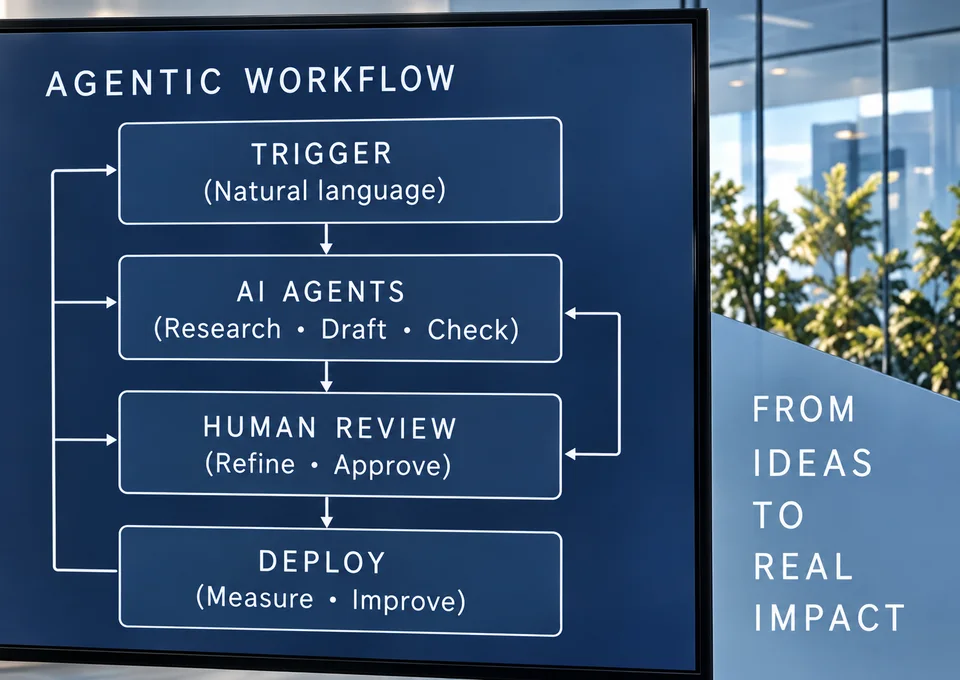
Specify what the agent is trying to accomplish, which tools it can choose, what context it needs and when it must ask a person. Design retrieval, reasoning and tool use around the actual task. Use straightforward automation where it is sufficient, rather than adding agent behavior everywhere.
Implementation & operating control
Scope the integrations, evaluate representative and difficult cases, define approval points and retain a record of consequential actions. Agree who owns monitoring, exceptions and ongoing changes before moving from a prototype to live use.
Where the capability can be useful
Sales intelligence & assistance
Bring approved vehicle and product information into a sales conversation. Interpret an inquiry, identify missing context and help the team prepare a more relevant next response.
Customer engagement & next actions
Use permitted customer context to propose a next step, select an approved tool and prepare follow-up. Booking, messages and record changes follow explicit permissions and approval rules.
Management & operating intelligence
Connect approved information to a recurring operating question. Surface an exception, its source and the next action for the responsible manager, rather than simply generating another summary.
Knowledge across tools
Explore how an agent can retrieve and use information across the tools already in place. Integration is defined per project; access to every CRM, DMS or channel is not assumed.
What an engagement can include
Business and data architecture; an agent specification; knowledge preparation; a working prototype; approved tool connections; evaluation cases; and a defined deployment and support scope. The starting point and delivery responsibilities depend on the system and information available.
How this differs from champion development
Build capability in your people.
Choose a participant and a useful first project. Coach their problem definition, tool use, checking and handover. The improvement can be a simple assisted task or automation; an agent is not required.
Build an intelligent system.
Define data and knowledge requirements, agent behavior, tool permissions, integrations and operating controls. The technical work is a separately scoped engagement, not homework for a beginner.
The two can connect. An internal champion may identify the need, supply process knowledge and own adoption, while the specialist team handles system design and engineering.
Automotive experience behind the practice
Dr. Jie Cheng’s background in automotive data, customer intelligence, predictive analytics and AI applications informs this work. His experience is relevant to both the business question and the technical design. Past company products and client relationships are not represented as AINERGY assets.
Explore Dr. Cheng’s background ↗See the distinction in a concrete example.
Our browser walkthrough separates context, tool selection, human approval and an action record. It is a deterministic illustration, not a connected AI product demo.
Explore the agentic walkthrough ↗